
A Is for AI Platform: The HAIKU Formula’s Second Element
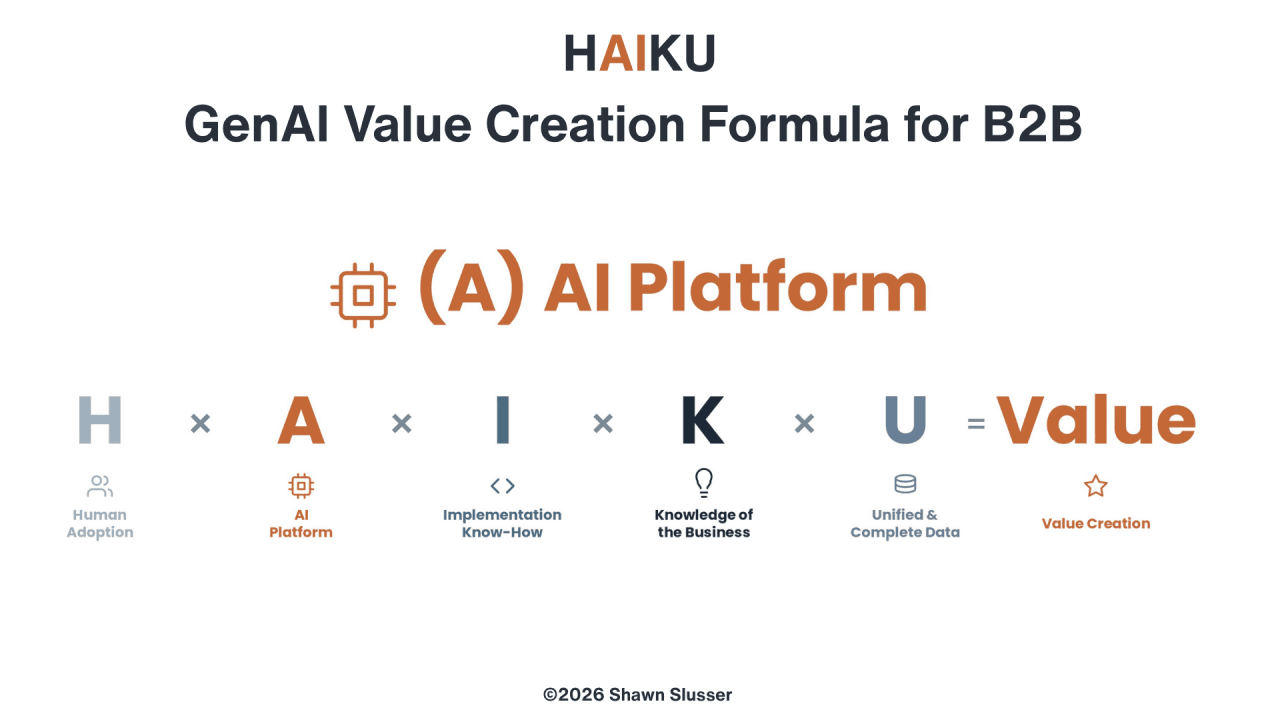
HAIKU Formula Series — Part 2 By Shawn Slusser, Slusser Advisory Group
In my HAIKU formula for GenAI value creation, A stands for AI Platform.
Where Most Executives Invest First
When executives start thinking about GenAI, the AI platform is almost always the first investment they make. OpenAI. Google. AWS. The demos are impressive, the vendor decks are polished, and the platforms themselves are genuinely powerful. That part is real.
What the vendors don’t tell you is that the platform alone is worth nothing.
The Platform Is More Than the Brand Name
When I say AI Platform, I mean the full stack: the large language models, the agent orchestration layers, the vector and data stores, the governance mechanisms, and the cloud infrastructure underneath all of it.
Most executives focus on the LLMs and the brand names. The full platform stack is considerably more complex. It includes agent orchestration frameworks that coordinate multi-step reasoning and actions, tool and API integrations that let AI systems interact with your actual business systems, memory and retrieval infrastructure that gives those agents access to your company’s own knowledge, and governance mechanisms that control what the system can and cannot do. Each of these components often comes from a different provider and requires deliberate design decisions. Enterprises who treat the platform as a single purchase rather than an integrated stack consistently underestimate both the build complexity and the ongoing investment required to keep it performing.
The Engine in the Parking Lot
Here is the analogy I use with every executive I work with. The AI platform is the engine. A well-built engine. Maybe the best engine ever made.
But an engine sitting in a parking lot doesn’t take you anywhere.
The platform requires two things to create value: it needs to be connected to your specific business process workflows, and it needs to be guided by deep knowledge of your industry and your business. Without those two things, the engine runs in neutral. The demos you saw in the vendor presentation were built for the demo. Your business is not the demo.
Why the Big Vendors Are Not Enough
OpenAI, Google, and AWS are building horizontal platforms. They are building for everyone, which means they are not building specifically for you.
Your industry has specific workflows, compliance requirements, and customer dynamics that large platform providers are not paid to understand. Their job is to give you a powerful, general-purpose engine. Your job is to figure out how to apply it to your specific context.
The companies moving fastest are not the ones who bought the best-known platform. They are the ones who paired that platform with niche specialists who understand their industry and who can move at the speed GenAI is evolving, which is genuinely fast and shows no signs of slowing down.
What a Strong Platform Decision Actually Looks Like
Most companies skip several things that separate a real platform strategy from a vendor relationship.
They evaluate more than one provider rather than defaulting to whoever sent the most impressive deck. They plan explicitly for vendor lock-in risk, because the landscape is shifting fast enough that today’s best choice may not hold that position in two years. They put governance mechanisms in place before scaling, not after a problem surfaces. And they assign a named owner: one person accountable for keeping the platform current as providers release new capabilities.
If you don’t have a named owner for your AI platform, you don’t have a platform strategy. You have a purchase order.
The Question Worth Asking Before Your Next Review
Ask one question in your next AI platform review: can your AI Platform owner describe in specific, concrete terms exactly how the platform connects to your business process workflow?
Not in theory. Not in the vendor demo. In your actual business, with your actual data, inside your actual workflows.
If the answer is vague, the engine is parked.
I’ll dive more into that in my next article covering the Integration know-how element.
Follow along as I break down each element of the HAIKU formula in future posts. Or schedule a call with me if you want to talk through how your GenAI journey maps to the formula.